Skip to content

Employee Ownership Blog

Corey Rosen

Will the Retire Through Ownership Act Reduce ESOP Fiduciary Risk?

President Trump recently signed the Retire Through Ownership Act (RTOA) into law. James Bonham of the ESOP Association says that the RTOA “strengthens confidence in the valuation process for millions of employee-owners and gives business owners a clearer path to an ESOP transition.” The very brief law states that “a fiduciary of an employee stock ownership plan as defined in section 407(d)(6) may make a good faith reliance on the principles and methodologies set forth in Internal Revenue Service Revenue Ruling 59–60 (as in effect on the date of enactment of the ERISA Adequate Consideration Act of 2025) in determining the fair market value of an asset described in such clause.” The RTOA states that nothing in the language limits the Department of Labor (DOL) from issuing regulatory guidance on how trustees should review ESOP valuations.

A new detailed analysis (member login required) by the NCEO looks at just how much impact this is likely to have. In the last 20 years, an average of about seven ESOP valuation cases have made it to court every year, some of which have been for clearly inappropriate acts. Many others come across as the plaintiffs’ bar seeking settlements. While this number is very small, the larger issue is whether fear of litigation discourages some business owners from doing an ESOP in the first place.

We asked members of the recent NCEO task force on ESOP valuation and the repurchase obligation what impact they think the law will have. There was unanimous agreement that it is a step forward but does not address the most common issues in litigation (overoptimistic projections, deal structure, control, and cases where ESOP shares were bought by insiders who then sold the company for a much higher price). These will need to be addressed by future DOL regulations if they are not to remain a subject of varying court opinions.

Corey Rosen

Tennessee to Help Fund the Costs of ESOP Feasibility Studies

The Tennessee Center for Employee Ownership (TNCEO) announced the creation of the Tennessee Employee Ownership Business Assistance Program. Funded by a $500,000 grant from the Tennessee Department of Economic and Community Development (TNECD), the program will provide technical assistance funding to eligible Tennessee businesses over the next three years. Eligible businesses may be reimbursed 50% of the cost of an ESOP feasibility study and transaction costs, up to $25,000 per business. 


Andrea DiMatteo

Making Space: Reflections from the 2026 NCEO Women’s Summit

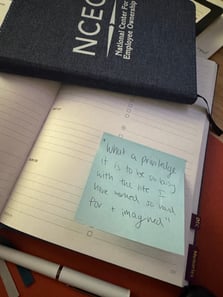
Womens Summit Quote

The NCEO hosted its Women’s Summit on October 6 and 7. This event is a highlight of our annual schedule—we in the employee ownership community are a fun and special breed, and the Summit is one of those events that really spotlights that. Together, we create space to learn, challenge assumptions, and support one another. I had the honor of facilitating this year’s Summit, holding space for our guest speakers and participants to dive into the content and network with colleagues across the employee ownership community.

Leadership is challenging, no matter if you’re leading yourself or a team of others. But leading while juggling the expectations of family, friends, and work? That is especially demanding. Our Women’s Summit carved out time for purposeful introspection with Gina Schaefer’s keynote and grounding moments with Brenda Bennett’s breathwork. Lorin Beller’s intention wheel set the stage for us to align with what we want, who we are, and how we want to show up. Taking the time to invest in ourselves is truly priceless, and it was great to see so many peers working together to better themselves. Together, we build better companies, flourishing communities, and a strong future for women in employee ownership!

I appreciate the opportunity to be in community with our fantastic members.

*The quote captured in the photo is one shared by a participant on our inspiration wall. I added it to my planner as a reminder of what to carry forward from our time in Detroit.


Corey Rosen

11th Circuit Overturns Administrative Remedy Exhaustion Requirement for ERISA Plaintiffs

In an en banc decision, Bolton v. Inland Fresh Seafood Corp. of Am., Inc., No. 24-10084 (11th Cir. Oct. 13, 2026) (en banc), the 11th Circuit Court of Appeals overturned a lower court ruling that required ESOP participants to exhaust all their administrative remedies before bringing fiduciary claims under ERISA in court. The decision brings the 11th Circuit in line with most of the other circuit courts. 


Timothy Garbinsky

Do Employee-Owners Have More Purpose at Work?

Many people spend roughly a third of their weekday working, and if they commute to work, that can easily add another hour or more daily. You might have more, you might have less, but the result is roughly the same: many people spend a sizable portion of their adult lives working. And while there are a great many things people look for in their work, a paycheck chief among them, more and more workers are hoping to find purpose in their work.


Eva Lianos

Rolling Up Our Sleeves in Detroit: Recapping the 2026 Repurchase Obligation Workshop

Nobody came to Detroit to sit back and listen. When NCEO members from across the country filed into the 2026 Repurchase Obligation Workshop, presented in partnership with Chartwell Financial Advisory, they brought their distribution policies, their plan documents, and a stack of questions they'd been saving up. For two days, the room worked.


Timothy Garbinsky

The Power of Telling Your Story

It’s a refrain that’s worth repeating: the strength of employee ownership isn’t in valuation methodologies, repurchase obligation studies, succession plans, or finance terms. It’s not found in plan documents or committee meeting minutes or proactive governance. The strength of employee ownership is found in the way all those things work in concert with the workers themselves and the work they do to change lives. And the best way to make that impact, that strength clear to people, be they potential new hires or local business owners or economic developers or to family around the dinner table, is through storytelling.